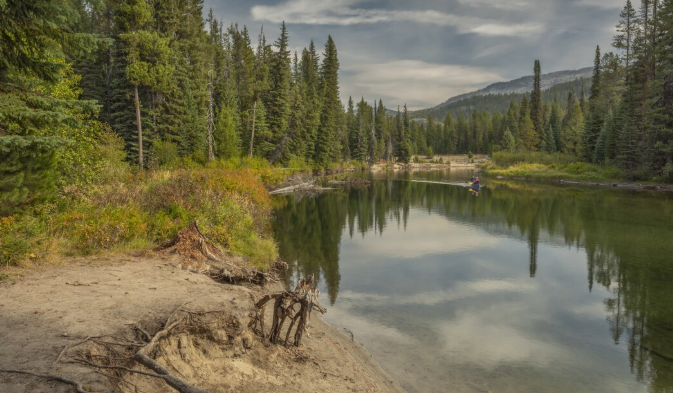
Michigan’s Upper Peninsula – The Last Truly Wild Place in the Eastern United States
Something changes when you travel long enough on US-2, past the Mackinaw bridge, and into the slow pine country beyond. The radio fades away. The billboards should give up trying so hard. Instead of counting exits, you begin to count miles by gas stations. It’s clear that you’ve entered a different version of the nation somewhere around Manistique, one that doesn’t exactly resemble the mental images of the Midwest that most people have.
The Upper Peninsula of Michigan has a peculiar place in American culture. It is home to only about 3% of the state’s population and 29% of its land, which accounts for almost everything. Over 16,000 square miles of land, home to about 300,000 people, are encircled by some of the biggest freshwater lakes on the planet. Given how many Finns settled here during the iron and copper era, the numbers feel almost European in their emptiness—more Finland than Florida.
It’s difficult to ignore how subtly the peninsula carries its past. Decades ago, the mines were shut down. The barons of lumber moved on. Kayak rentals and pasty shops are the main sources of income for towns that used to ship ore to power American steel, and they do so with little fuss. You might as well enjoy the lake while it’s flat because the U.P. seems to have learned long ago that booms end and that whatever comes next will most likely end too.
The aspect that people undervalue is the wildness. Here, wolves continue to cross logging roads. In Marquette County, moose wander into yards. One of the largest remaining areas of old-growth northern hardwood forest in North America can be found in the modest Porcupine Mountains, which are not quite 2,000 feet high. This statement should come as a shock. That kind of unspoiled land is simply nonexistent in many areas east of the Mississippi. Here, it does, in part due to carelessness and in part due to obstinate design.
In October, you can hike the Escarpment Trail above Lake of the Clouds and stand by yourself, perhaps with two other cars in the parking lot, while you watch the maples burn red against a black-blue stripe of water. On a fall weekend, try to find that kind of solitude in the Smokies or the Adirondacks. The U.P. portion of the 4,600-mile North Country Trail, which stretches from North Dakota to New York, may be its most picturesque and isolated section. Locals are aware of this. They don’t speak so loudly.
This place has a certain pride that outsiders occasionally confuse for animosity. The locals refer to themselves as Yoopers, which evolved from a phonetic joke to something more akin to an identity. Every now and then, the idea of splitting off and creating a 51st state—often referred to as Superior—is proposed. It never moves. However, the fact that the topic is still brought up, generation after generation, indicates how isolated this area feels from the rest of Michigan and possibly from the rest of the United States.
Summertime is brief and full of life. Houghton frequently gets buried in more than 200 inches of snow during the long, somewhat mythical winter. It’s mostly mud in the spring. However, fall is the time of year when skeptics are converted. At dawn, the lakeshore turns glassy, the light becomes honey-thick, and the inland forests put on a show that more well-known areas would charge to enter.
It remains to be seen if the U.P. will continue in this manner. A few newcomers have moved north due to remote work. Campaigns to promote travel to Pure Michigan continue to increase its visibility. The population of moose and lake ice are being affected by climate change in slower and more peculiar ways. But for the time being, the peninsula is still what it has always been: a peaceful, untamed, and mostly ignored area of the eastern United States where the forest continues to win more debates than it loses.


You May Also Like

Overtourism Is Changing These 10 American Destinations Forever — Locals Have Officially Reached Their Limit

America’s Airport Makeovers – The 9 U.S. Airports Completely Transformed in the Past Two Years
