The Forgotten Great Plains Town That Has Better Prairie Landscapes Than Anything in South Dakota
After a sufficient amount of time spent driving west on Interstate 90, the terrain starts to flatten in an almost confrontational manner. Billboards become less common. Cell service falters. Beyond the Missouri River, the prairie expands to such an extent that the horizon ceases to appear as a line and instead takes on the appearance of a suggestion. The majority of tourists focus on Wall Drug signs and the prospect of the Badlands in the distance. They completely miss Okaton’s exit, which is presumably how Okaton likes it.
Okaton is hardly a town anymore. A few fence lines collapsing into themselves, a long-closed gas station, and a scattering of weathered buildings. While some curious people occasionally stop by the nearby Petrified Wood Park, most visitors only stay for fifteen minutes before departing. I believe they are departing prematurely. Because the land starts to do something that the more well-known parts of South Dakota hardly ever accomplish just beyond the deserted main strip. It becomes quieter. It ceases to function.
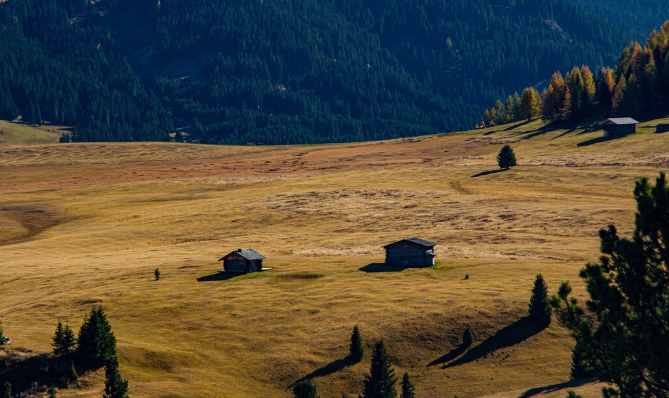
One of the issues with the Badlands is that they are theatrical. They are aware that they were made to be photographed. Families can be seen posing against eroded spires that, according to a National Geographic article, lose about an inch of cliff face annually as tour buses idle along the Loop Road during the summer. On stage, it’s a landscape. In contrast, Okaton’s prairie makes no demands of you. It just sits there, rolling out in that expanse of mixed grass that used to stretch from Manitoba to Texas before the majority of it was destroyed by plows and pavement.
Ecologists continue to draw attention to this area of central South Dakota for a reason. For many years, the Nature Conservancy has worked to preserve remnants such as Altamont Prairie, which is located further east. In the 1960s, botanists were already referring to these small, unplowed grassland islands as botanical museums. Okaton’s surroundings feel the same way. Long, uneven waves of bluestem are caught by the wind. At dusk, pronghorn drift through. Prairie potholes sparkle between the rises in wetter years like dropped and forgotten coins.
It’s difficult to ignore how few people are present. Perhaps a rancher in a dented pickup. From a fencepost, a meadowlark performs its slow, melodic show-off. This location is close to the 100th meridian, an ancient climatic boundary that author Wallace Stegner studied for a lifetime. It is where eastern moisture gives way to western dryness and, to be honest, where American optimism about farming kept running into problems. Okaton’s history is palpable. The windows with boarding are not ornamental. They are the result of a location that the rain largely overlooked.
It’s actually unclear if the town will survive in any recognizable form. For years, the population has been in the single digits. As they have done for decades throughout the northern plains, younger residents are drawn to places with broadband, such as Rapid City or Sioux Falls. Preservationists are quietly debating whether or not communities like Okaton should be permitted to gradually revert to grass and reintegrate into the prairie they once disrupted. It’s the type of question that lacks a clear solution.
But the light is what I find myself returning to. The grasses here turn an almost coppery gold in the late afternoon, and the sky appears to gently descend over the ground, a characteristic of prairie skies. No spires. No crowds. No store selling gifts. Just a half-dead highway, a forgotten town, and some of the most pristine prairie remaining in a state that built its tourism brand on louder, lesser views. If you’d like, tell others about it. However, if they continue to drive in the direction of the Badlands, don’t be shocked. Certain locations are only accessible to those who take the time to stop.


You May Also Like

What to Know About Used Yachts For Sale in Singapore

Baton Rouge Food Tours